Sunday, December 30, 2012

Figuring Out Free Agency

The offseason is a fun time to be a fan. Every team will shuffle their rosters, drop, add, cut, sign or arbitrate players based on their belief on what changes need to be made. Fans and writers pay special attention to the free-agent class every winter. Every year there are a handful of questionable moves that leave everyone wondering "what where they thinking?" In an effort to help you, hopefully, better understand your teams moves here are some observations I have made looking over the past few years.

Losing is Hard to Break


When was your teams last winning season? When did they last compete in the playoffs? If it was more than 4 years ago, expect your team to overspend on free agents, and even that might not be enough. No one enjoys losing and athletes like it even less. Most of the top free agents will forgo a few million dollars to avoid playing on a team that doesn't have a chance of winning the World Series. Last season the Orioles couldn't lure a top free agent no matter how much they were willing to offer, when Mark Texieria was a free agent he opted for the Yankees and slightly less money than the Orioles offered. This season we have seen the Mariners get rebuffed by Josh Hamiltion (Angels), Nick Swisher (Indians), BJ Upton (Braves), and probably some others I have not yet heard about. New field dimensions be damned, these players do not want to waste their prime years merely playing the game, they want to play for October glory.
Those players who are willing to take money ask for, and receive, a king's ransom. Jayson Werth is easiest example, coaxing a then-losing Nationals team to give him more years (7) and money ($126 million) than any other team admitted to be willing to commit to him. This season two pitchers seemed to play the team against itself to get either more money (Jeremy Guthrie, Royals, 3/$25m) or years (Edwin Jackson, Cubs, 4/$52m). Nick Swisher with his 4/$52m deal with the Indians strikes me as another overpay. These players were able to convince a team to bid against itself in order to land their targets even when no other teams were willing to come near the terms agreed to. When it works the team starts to win and players are more willing to come over closer to market rate. The Nationals gamble on Werth paid off, they are now a top choice for players. The Orioles are now on the short list for players after their first winning season in 15 tries. They may have not signed any big names yet, but it is a start that other teams would pay for.

Pitching, Pitching and More Pitching


Pitchers get paid. True Kyle Lohse and Rafael Soriano highlight a list of free agent pitchers still available, but those who have signed are getting paid. Jonathon Broxton (Reds) and Brandon League (Dodgers) both landed 3/$21+million presumably to close. Neither are quite where Soriano goes and both have had issues in the recent past, but closers tend to get paid. Sean Burnett, Angels (2/$8m) and Mike Adams, Phillies (2/$12m) are getting paid handsomely to set up. There are still enough unemployed pitchers for bargain hunters, but for as much as GMs complain about the volatility of relief pitchers they spare no expense when addressing their own weaknesses.
Aside from the starters previously mentioned, Zack Grinke (Dodgers) has the offseasons top prize 6/$147m. It seems every year the top pitcher can name their price whether in years, average annual value, or total dollars and someone ponies up the dough. Other starters are not left searching for scraps either; Jeremy Gutherie and Ryan Dempster (2/$26.5m) from the Red Sox shows that if you have a track record teams will overlook a truly dismal performance for half a season when writing the checks. Francisco Loriano, Pirates (2/$12.75m), Tim Hudson, Braves (1/$9m), Dan Haren, Nationals (1/$13m) show that injuries and ineffectiveness are no barrier to an eight figure payday, and this is without mentioning Jorge de la Rossa, Rockies (1/$11m). If you can pitch long enough to show promise or longevity, someone will step up and extend your career and fatten your wallet in the process, not a bad gig if you can get it.

Never Underestimate an Owner


Finally, when a big free agent is available and the "mystery team" surfaces, look for the deep pockets of sole owners. George Steinbrenner made a habit of spending big on what he wanted, and usually getting it. Since his kids took over the operation the spending has been somewhat curtailed, but the pattern still rings true. Last year Albert Pujols was going back to the Cardinals, everyone knew it, all that was out there was some "mystery team" showing up late. Some players may use that specter as a marketing ploy, but Arte Moreno of the Angels was the wealthy old kook willing to outspend the Cardinals, by a large margin, to land the prized free agent. For these owners it is not about team needs as much as personal wants. These owners know they do not have a long time left and want to win a World Series before they go, so  they will shell out whatever they feel necessary for that pursuit. Moreno was at it again this season, landing Josh Hamilton (5/$125m) with barely a whisper of his interest. Mike Ilitch of Detroit is another such owner. Last season he shocked everyone by signing first baseman Prince Fielder for a kings ransom (9/$214m), despite having perennial MVP candidate Miguel Cabrera at the position. They were four wins from that gamble working out and Cabrera certainly appreciated the protection. Ilitch is back at it this offseason, signing Anibal Sanchez (5/$80m) over the Cubs and I would not be shocked if he does not open the pocket book one more time to get Rafael Soriano sometime in January.

To recap: if your team has a history of losing expect longer or more expensive contracts for just about any player. If your team is targeting pitchers, going cheap will not help land their target players, at least one other team is likely to show interest and flash a bit more cash. And finally, if the team has an aging owner, do not be surprised on anyone they go after, and likely land. There are plenty of other factors that make up the actions of teams in the offseason, these three just stick out to me. Feel free to let me know if you notice something else.

*Contract information was from MLBTR 2013 Free Agent Tracker

Friday, December 14, 2012

Yankee Plan Doesn't Add Up

Try as I might, I just cannot understand the mentality of the New York Yankees. On the one side they are preaching a need, not a desire, an actual need to get under the luxury tax in 2014. This makes sense, the new collective bargaining agreement drastically raises the taxes repeat offenders will pay every year. However, if a team falls under the luxury tax amount the tax rate resets. It is one thing to have one of the top three payrolls in the majors, it another to needlessly pay more for the privilege to make that claim. Paying the luxury tax leads to revenue sharing among the other teams and the Yankees have paid $224.2 million in luxury taxes over the past ten years --or slightly less than the Dodgers payroll appears to be for 2013. Staying under the level will allow the Yankees to keep a higher payroll than most while still fielding a contending team. As I said, this makes sense. It is how the Yankees are going about it that leaves me baffled.

The Yankees have made a priority of signing 1-year contracts this offseason to aging veterans. To date they have signed Mariano Rivera, Andy Pettitte, Hiroki Kuroda, Ichiro Suzuki, and Kevin Youkilis. At 33, Youkilis is the youngest player signed by 5 years. They are not a terribly young team, their farm system was generously listed in the top 10 according to Fangraphs. These rankings are in flux right now and will be reviewed and redrafted sometime before opening day. That said, they lack high ceiling pitching in their farm system and given the contracts they are handing out they do not expect any fielding prospects to make an impact in 2013 either. (I am not an expert on minor league systems so if you wish to challenge me on this, please feel free) They still feel they are in a window of opportunity to win the world series and going for it is cash out of their wallet not mine. However, they are overpaying for these additional veterans to the point that they have little to no trade value.

Every year at the trade deadline teams will eat some money and trade a player for a better prospect, the money the Yankees would have to pay to do this makes such moves "head-scratching" at best. As Cots points out in their Yankee spreadsheet, the Yankees have $183 million on the books this season, before including arbitration players or Ichiro's money. In 2014, $75 million for 4 players, and that does not include Robinson Cano, Curtis Granderson, Ichiro, or any of their arbitration players. The luxury tax is $189 million for 2014. So they will have around $115 million to play with, enough to run the entire payrolls of most teams. However, lets assume they go after, and get, Cano for an average value of $20 million a season. Toss in Ichiro's deal at $6.5 for 2014 and the arbitration eligible at $10 million players (currently 8 possible arbitration players, average $1.25 million/player). So 14 players for about $111 million. This leaves $77 million and still there will be holes in center, catcher, the rotation, the bullpen, and possibly shortstop. They will not boot Jeter out the door either, if he wants to play in 2014, he will get paid well to play "the Captain" if not for his on field production.

Add it all up, and that cap space diminishes rapidly. These are the Yankees, they do not do small, they do not deal with minor free agents. They will spend for a big arm because they need pitching, want to win, and do not really have much they can trade to get it right now. I say this thinking that Michael Pineda comes back and is a useful pitcher for them. They need to infuse some youth into their organization, useful, affordable parts that grow into the franchise. These players do not need to take over for the current players, they need to provide cost effective play and serviceable trade chips that their farm system is not currently providing. This would lower payroll while providing more cost certainty going forward. I do not understand their mentality of overpaying veterans this year and expecting anyone to think the same thing won't happen next off-season when their core is another year older and their holes still exist. Maybe they know something I don't, but maybe they have been looking at themselves in the mirror for too long.

Sunday, December 9, 2012

Player-coaches, a Thing of the Past

The idea of the player-coach is dead. This should not be major news, Pete Rose was the last player coach in any of the big three sports back in 1986. The collective bargaining agreement in the NBA prevents the practice. Though it has been 26 years since the player-coach has been seen, it is an idea that refuses to die in the minds of fans. Amid the fallout of the New Orleans Saints Bounty Scandal was the notion of Drew Brees serving as coach for this season. The Chicago White Sox toyed with the idea of replacing Ozzie Guillen with first baseman Paul Konerko. Jason Giambi hinted at a desire to take the role early in the Colorado Rockies managerial search. He later announced that he would retire, if chosen as manager, but once again the idea sparked the imagination and left many wondering who the next player-coach could be. Aside from some fun speculation over beers with your friends, don't waste your time. The era of the player-coach is dead and it is not coming back.

Modern sports have devolved (or evolved depending on your view) from great all around players who could play any position to specialists. Pitchers are not just pitchers anymore, nor are they simply starters and relievers. Starters are "aces" "workhorses" and "back of the rotation arms". Relievers are "closers" "set-up men" "long relief" "middle relief" all the way down to "LOOGYs" (left-handed one out guys). Fielders are increasingly being labeled "platoon" players, benched against a right or left-hander based on advanced metrics designed to help give their team a competitive edge. Rare is the football player who plays offense and defense into college. Receivers are now "speed guys" "route runners" or "slot men." Most teams have a center, a backup center and a long-snapper. Is snapping the ball 10 yards so difficult that it requires a specialist? I would hope not, but the position exists. You can do this with just about every position on the field. The closest to a diverse talent you see anymore is a receiver/return man, but even then it is usually a mediocre receiver because if they are good receivers their return days are over.

In addition to the players, the duties of coaches have increased tremendously over the years. In baseball a staff will include the manager, a bench coach, a third base coach, a first base coach, a pitching coach, a bullpen coach and a hitting coach. Most recently a trend of hiring two hitting coaches has emerged and it wouldn't shock me to see a film coach added in the future. Managers no longer set a lineup and say "play ball," instead they have to study the lineups and tendencies not only of their roster, but the opposing pitchers as well. They have to manage egos and injuries and off field issues more than the game itself. Connie Mack has likely rolled over several times in his grave at how much players are catered to in the modern game.

Football is no better. There are head coaches, assistant coaches, offensive and defensive coordinators, not to mention line coaches, secondary coaches, quarterback coaches and on and on. The pace and scheme of the modern game demand the attention of such specialists and even then it might not be enough. Without Sean Payton, the Saints have been just 5-8 this season and have gone from potential Superbowl challengers to struggling to make the playoffs. Drew Brees is back, but the offense has struggled between stagnant and terrible all season. I doubt their record would improve if Drew Brees had more on his plate.

The largest factor in keeping the player-coach out of the game is the General Manager. General Managers are almost constantly on the hot seat. The wrong hire, the wrong personnel and they might not be around to fix the mistake. Increasingly these GMs are relying on advanced statistics and data to make their choices in their hires. They will compile reams of data on a player or a coach to fill one role. They are less informed about a players ability to handle coaching duties and increasingly less likely to take the risk.

While it may be fun to speculate Brees or Payton Manning or Ray Lewis or Alex Rodriguez coaching and playing their final season(s), keep in mind it will likely not come to pass. It is a notion that now belongs in sports history, but I doubt fans will ever stop speculating about it, and there is nothing wrong with that. 

Saturday, November 24, 2012

Coaching Blunders Make College Football So Entertaining

I enjoy college football. You enjoy college football most likely. It makes for fun and exciting entertainment on Fall Saturdays (or Tuesdays, Wednesdays, Thursdays, or Fridays). Part of what makes it so fun is its unpredictability. Every game could can be a coin flip, if a star player goes down that could spell disaster for the season. We love the mass hysteria it creates, we loath the frustration our respective teams create for us. After watching games all season a few things generally strike me as the bane of a fans existence.

1) Not capitalizing on turnovers (especially at home). You know this scenario, your team gets an early turnover deep in opposing territory (say the red zone or just outside). They go for the quick play to the endzone and miss. They hand it off for maybe 2 yards. Third down they get maybe 3 more. 4th and 5 less than five minutes into the game and the coach goes for the touchdown. It fails. This is terrible on every front. Their defense knows your team can be stopped. Your offense fails to score points. All positive momentum is stymied on four plays, at home this can suck the life out the fans making it easier for the opponent to really seize momentum. The better plan is to go for it all, but accept 3 points when they are there. Of course you want touchdowns, but it makes the opposition feel worse when they turn the ball over AND give up points less than a minute later.

2) Being down by multiple scores and mismanaging the clock. Team down by 4-11 points and 6 minutes or left remaining. The team gets to the red zone, but stagnates. Yes we all want them to push on and make it happen, if this were a video game we would save the game and reset the scene until we succeeded. Our team doesn't get that luxury. March in, go for the quick score. Go for the two or three plays that either work or end in a penalty on the other team to get that touchdown. But know that it is a two score game and running into a brick wall defense is only going to kill the clock. Take the first score presented to you and allow your fans to hope for the best.

USC v Notre Dame was a prime example of this going wrong. Around 5 minutes remained in the game and they were within the red zone. They tried the same fade route to Marquis Lee on back to back plays. Both were under thrown, both resulted in pass interference penalties. Lane Kitten Kiffin followed this up with 3 straight running plays that neither got them into the end zone nor managed the clock. Not the end of the world to lose some clock time, but they needed a score. Naturally, Kiffin went for it, the pass was again under thrown and Notre Dame took over. This is poor coaching more than fault on the players. They needed two scores so get the first one and at least give your team a chance. Fans tend to appreciate such efforts.

Truly these are the two "killer" scenarios that came to mind for me. Icing the kicker might be one, but given how terrible kickers have been this year overall I decided to give them a pass. Kickers can't win and their coaches shouldn't organize their play selection to make them out to be the goat. I know there are others and I am curious to know what irks you most as a fan. Let me know in the comments below.

Friday, November 16, 2012

Upon closer inspection Ute fans should have seen this coming

Loyalty is a funny thing. It can cloud the judgment of those it infects into ignoring history, talent, and cold hard facts. No amount of logic will sway the loyal until after the fact and even then one is likely to get an apologists version of events. Utah Ute football fans fell victim to the siren song of loyalty and as we near the end of a second season in the 12 PAC their critics are pointing out flaws in their loyal proclamations of early success and the faithful are bemoaning injuries as the culprit. Both are right, both miss the point. Utah faced a tough road in its transition from the Mountain West to a power conference, but their fans looked more to recent history than to the distant past for guidance. It was a classic case of not seeing the forest for the trees. We can now look back and see not just what should have been obvious, but what to expect going forward as the Utes seek their first conference championship.

To be fair, the aughts were not just good for the Utes, they were great. Coaches changed, but still the Utes kept winning. Ron McBride (88-63) was fired and Urban Meyer (22-2) built upon that foundation and led the Utes to an undefeated 2004 season and bragging rights as the first non-BCS conference school to not only make a BCS bowl, but to win won. Urban left and Kyle Whittingham (70-31) took over. Four years later the Utes became the first non-BCS conference school to twice be invited to a BCS bowl and win. Utah went 2-0 against the mighty SEC in those bowl games even when they had to go down to Georgia the second time.

Shortly after that the Utes got the dream invitation of all mid-major programs, the chance to move up to a power conference. They left longtime rival BYU behind and looked to embrace new rivalries and a brighter spotlight. Ute fans were ecstatic not just for the move, but to thumb their noses at the team down South. Scandal and scheduling did nothing to dampen the joy. USC was hit hard with sanctions stemming from Reggie Bush that would impact USC during the first years of Ute membership. The conference was divided North and South and by great fortune rising powers Oregon and Standford were left off the Utes schedule their first two years. The only way they would possibly meet was in a conference championship. Utah was among the elite of the mid-major programs nationwide and other than USC the 12 PAC South did not look too intimidating. This was the short sighted history fans chose to accept and crow from the rooftops at just how high Utah might rise, refusing to recall the lessons of Icarus, refusing to accept just how difficult a challenge their team was facing.

Had Ute fans looked beyond the Crimson colored end zones of Rice Eccles stadium, they would have seen the graveyard that was mid-major programs upon making the jump to "real conferences". My focus here is on teams that jumped up to the PAC. As Arizona and Arizona State learned when they left the Western Athletic Conference back in 1978, it is not an easy transition. Arizona went 5-6 overall its first season (3-4 in conference) and finished tied for 6th. They would not make their first bowl game as a member of the PAC 10 until 1985 and did not win the conference until 1993 (their only PAC 10 championship). Arizona State has been a little better, finishing 9-3 overall (4-3) and tied for 4th their first year, when they also made their first bowl game. ASU has won the conference three separate times, the first coming in 1986. Now Utah was not terrible overall in its first year, finishing with an 8-5 record and a bowl victory. However, the Utes went just 4-5 in the conference and clearly struggled with the week-to-week grind.

This has been a respectable season, but not what Ute fans were used to and through solid play late last season, Ute fans came back with renewed optimism. Alas, Utah already has 5 in-conference losses this season and will be pressed just to match last seasons record. Moving up in competition comes with its bumps and bruises. Utah fans have every right to believe that it will not take 7.5 years to win the first 12 PAC championship, but in hindsight it was foreseeable that Utah would struggle and it might take a few years to match the personnel on the field necessary for their team to win. The first two seasons did not deliver the fairy tale endings Ute fans envisioned, but in two or three years when their recruits are on par with the rest of the 12 PAC don't be surprised if they capture that crown. 

Tuesday, November 13, 2012

Loria Security Lies with Bud

Earlier today we learned about a blockbuster trade between the Miami Marlins and the Toronto Blue Jays. While the trade has not been made official yet, it is likely just a matter of time. It took Jeff Loria, owner of the Marlins, less than 12 months to get rid of three All-Star caliber players signed to long term contracts and take the team payroll from $98 million to around $16 million dollars. The only most notable player left in Miami is Giancarlo Stanton. Don't be surprised if major news outlets attempt to spearhead a campaign to have Bud Selig force Loria to sell the team. Don't be surprised when that call falls on deaf ears.

Bud Selig after all is the man who supported his efforts as the then owner of the Montreal Expos to seek a city-funded new stadium. When Montreal (wisely) rejected the demand Loria, Selig, and then Florida Marlins owner John Henry came up with a plan to allow Henry to sell his team to Loria, Loria to sell his team to the Commissioners Office, and Bud to get approval from the rest of the league owners. Once sold, Loria moved on to become owner of Florida, Henry relocated to Boston and within 2 years each had a World Series ring. Nothing has smelled quite right on these people since.

Loria took over a new team, won the World Series in 2003 and immediately dumped most of the talent making more than the league minimum. When holdovers, Miguel Cabrera and Dontrel Willis, got too expensive he shipped them to Detroit. Loria then said he was going to try and build a winner, including signing then face-of-the-franchise Hanley Ramirez to a contract extension along with Josh Johnson. This helped convince the Miami City Officials to approve a taxpayer funded new stadium which was followed up with large contract free agents last winter. Once again Loria has dumped talent while keeping a young, affordable slugger behind only now he plays in a gaudy new stadium. Keep an eye on the batting prospects Toronto is giving up because odds are good Giancarlo's replacement is among them.

I spoke about John Henry in my first post and do not have much to add on him here.

Bud Selig has supported Loria every dirty step along the way. He not only let Loria change ownership, he helped Loria get a $38 million dollar interest free loan from MLB to buy the Marlins. He attempted to have Montreal contracted along with the Minnesota Twins after the sale went through. He refuses to bat an eye on the salary dumps. He supported Loria's efforts to get the new stadium funded, it helps support MLBs bottom line. More importantly to Bud, it is another new stadium that he can put on his list of "accomplishments" during his tenure as commissioner. Loria already ranks among the worst owners in professional sports, so hits to his credibility cannot possibly do much more damage to his reputation. 

Should Loria be forced out as owner of the Miami Marlins? Yes, preferably with a fine that diverts any profits from the sale going first to paying off the stadium before he gets anything. Will it happen? No, his actions have been endorsed by Bud Selig for over a decade and it is too much to hope that Selig did what was right for baseball fans everywhere. So what can be done? Boycott anything related to the Miami Marlins, even if they visit your team on the road. Empty stadiums will get the league interested. It is a decade late, but America can no longer ignore just how terrible Jeff Loria really is. Who said Canadians were slow?

Wednesday, November 7, 2012

A Layman's Guide to the 12-PAC

The 12-PAC is in its second football season, but I understand some people are still trying to sort out who ended up where in all the conference realignment that has taken place recently. In order to help you out, I present my walk-through of the 12-PAC*.

(* if you insist on calling it the PAC-12 I assume you are under 21, or just no fun)

It is a veritable jungle out West and if you are a fan of the Utes
I don't get Swoop in the least and do not recognize it as a legitimate mascot

your best bet is to come hungry and be well prepared to tackle some Buffalo,

 stalk some Wildcats
  
Yeah there mascot isn't a female, but you probably didn't notice until you read this anyway
or go Duck hunting.
  
I prefer open water Duck Hunting

You even have a sporting chance to bag your choice of bear: Golden
That might be the ugliest mascot ever
 Or Bruin
Attempting to hide behind the scenery

But proceed with caution or you may be fall victim to the Sun Devils.
Consider me tempted by the Devils (Cheerleaders)

If you can survive the jungle you are halfway done. The nightlife is calling and what better way to being than by wrapping up the Trjoans
Judging by the beanie it must be December

before blitzing some Beavers.


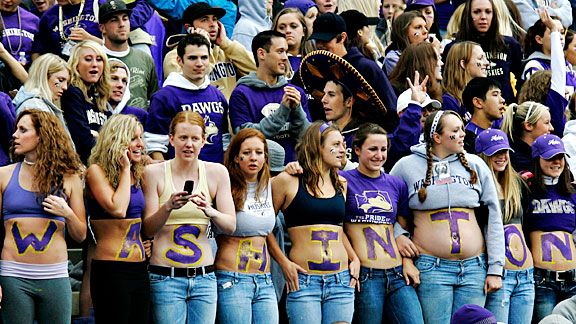
Still up for more? Then head to the Northwest where you can try hold down the Huskies
Not the best spelling team out there

or sack energetic Cougars.
Not a bad scoreboard distraction
No matter your game plan you better be prepared because any opportunity for success may also leave you high and dry like a Cardinal in a Tree.
Um, yeah
So now you have a better understanding of what awaits you in the 12-PAC, happy hunting.